Used radial arm drills handle holemaking across bulky fabrications that cannot fit standard drill presses. When evaluating machines like a Soraluce Model S4 or Asquith ODI, focus on arm deflection, column clamping security, and spindle backlash. Arm reach and Morse taper size dictate whether a machine can handle your workshop drilling patterns.
Industrial radial drills bore, tap, counterbore, and ream heavy workpieces clamped directly to base plates or box tables. Unlike upright pillar drills, the spindle head travels horizontally along an arm that swivels around a vertical column, letting the tool reach points across wide plates without shifting the component. Radial configurations are categorized primarily by arm working radius, which dictates reach from column center to spindle axis, and column diameter, which ensures rigidity during heavy cuts. Key operational parameters include maximum drilling diameter in solid steel, spindle travel stroke, feed rate stages, and the Morse taper internal bore (typically MT4 or MT5) that secures large shank twist drills.
Check the arm-to-column locking mechanism thoroughly. Manual or electro-hydraulic clamps must lock tight without arm skew, as slip during hole breakthrough breaks large core drills. Mount a dial indicator on the spindle nose to evaluate play in the quill and verify runout across extended travel. Inspect the arm elevation screw, bronze safety nut, and bevel gear transmission for stripped teeth or thread thinning from dry cycling. Look for score marks along the cylindrical column and the horizontal guideways of the arm where the drilling head traverses. Test the mechanical feed trip stops and reverse clutch engagement, which are essential for repeatable blind tapping without destroying threads.
The yard holds radial arm drills built for structural fabrication and heavy plant repair. Stock includes long-reach European engineering such as the Soraluce Model S4 with a 7-foot-6-inch arm, alongside the heavy-duty Asquith ODI. Compact operations are served by British Adcock & Shipley 36-inch units and 3-foot Russian radial arm drills. All machines can be inspected at the Nashik yard before purchase.
Available Now
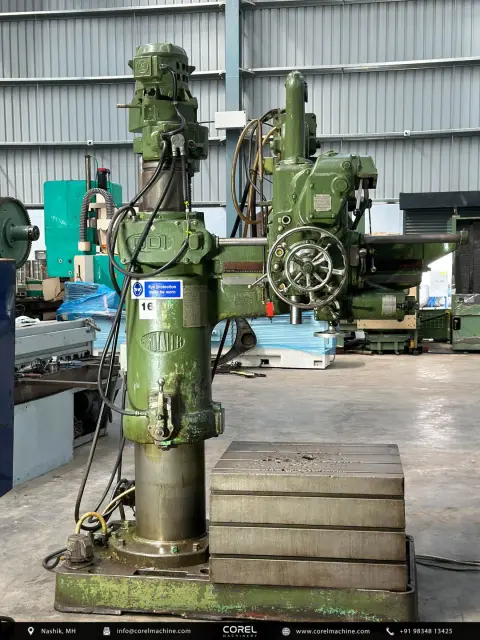
Asquith ODI Radial Drill
- Stock No.
- 3322
- Capacity
- ARM LENGTH 1350 MM
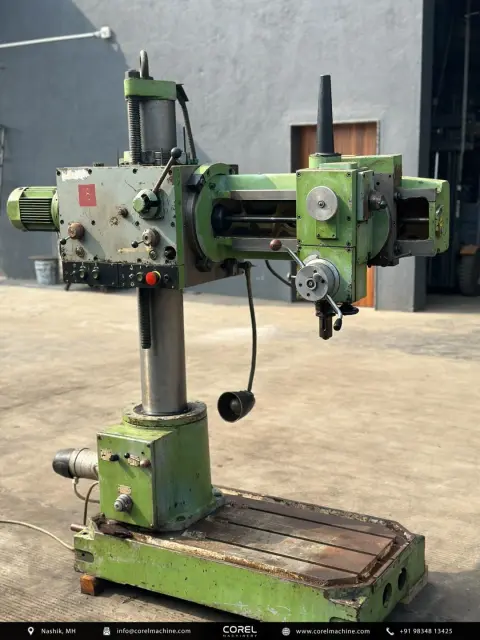
Russia 3FT Radial Drill
- Stock No.
- 3305
- Capacity
- 3FT
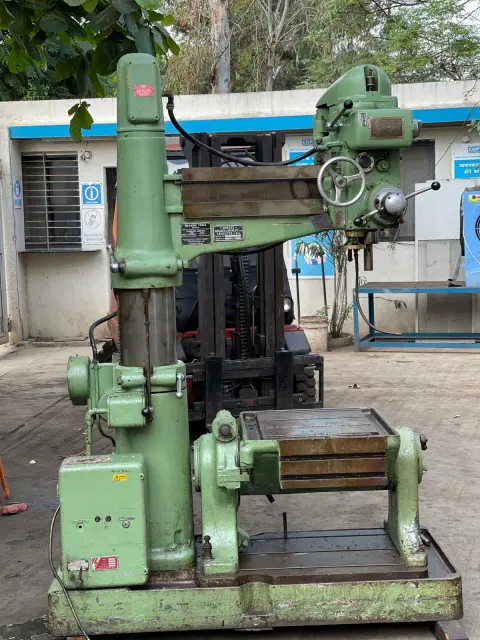
Adcock & Shipley 36″ Radial Arm Drill
- Stock No.
- 1071
- Capacity
- 36"
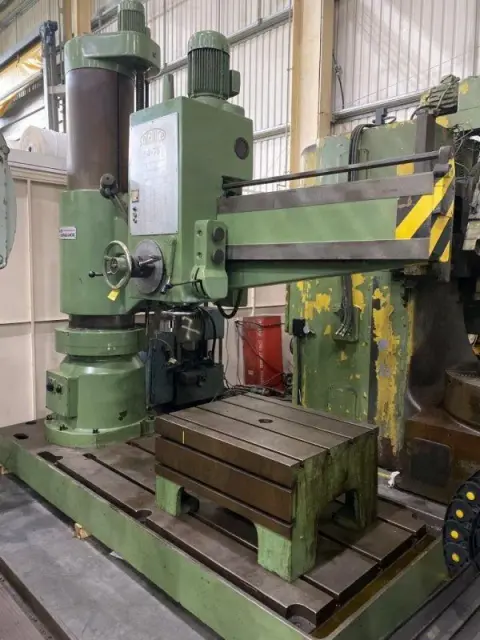
Soraluce Model S4 – 7’6” Radial Arm Drill
- Stock No.
- 974
- Capacity
- 7'6"
Used Drilling Machines delivered across India
Used and second hand drilling machines from our Nashik yard are running on shop floors in Pune, Mumbai, Nashik, Kolhapur, Aurangabad, Bengaluru, Hosur, Chennai, Coimbatore, Delhi NCR, Faridabad, Ludhiana, Rajkot and Ahmedabad. We ship anywhere in India and export worldwide.
Frequently Asked Questions
What Morse taper sizes are typical on these radial arm drills?
Medium to heavy radial drills like the Asquith ODI or Soraluce S4 generally feature MT4 or MT5 spindle sockets. These accommodate large-diameter drill shanks, boring bars, and heavy reduction sleeves directly without slipping under heavy feed pressure.
How do I check for column deflection during heavy drilling operations?
Mount a magnetic base dial indicator on the base table with its pointer touching the lower edge of the arm. Apply downfeed with a dull bit on scrap stock; excessive needle movement indicates worn column sleeves or improper clamping tension.
What is the operational difference between the Soraluce S4 and compact 36-inch drills?
The Soraluce provides a long 7-foot-6-inch arm reach for drilling massive castings, boiler sheets, and wide assemblies. A 36-inch machine like the Adcock & Shipley fits tighter workshop footprints and excels at repetitive work on medium motor frames and smaller brackets.
Can tapping operations be performed directly using the spindle drive on these machines?
Yes, heavy radial drills incorporate mechanical or electrical spindle reversing clutches operated via the central control handles. This lets the operator feed taps into pre-drilled holes and back them out cleanly without requiring specialized external tapping heads.