Used horizontal machining centers (HMC) feature side-mounted spindles that let heavy chips fall away naturally during deep-pocket cuts and prismatic milling. They run multi-sided jobs on tombstone fixtures with minimal setup changes. Inventory includes Fanuc-controlled models from Japanese and Taiwanese builders like OKK and Mori Seiki, built between 2001 and 2008.
Horizontal machining centers are built for batch milling of engine blocks, gearbox housings, pump bodies, and aerospace components. The horizontal spindle axis allows gravity to clear hot chips, preventing re-cutting and thermal distortion inside tight pockets. Most configurations incorporate an integrated B-axis rotary table and automatic pallet changers so operators can load raw castings while the spindle works inside the enclosure. When comparing models, spindle taper size (typically BT40 or BT50) dictates cutting torque, pallet dimensions (such as 400 mm, 500 mm, or 630 mm) fix the component envelope, and rapid traverse rates govern cycle times on multi-face indexed parts.
When assessing an HMC, check the B-axis rotary table gear backlash, curvic coupling teeth, and clamping mechanism under load, as positioning errors multiply across tall tombstones. Examine the automatic pallet changer sequence for smooth unclamp, rotation, and seat confirmation; worn pallet lock cones cause alignment steps between setups. Inspect telescopic way covers and internal chip augers, since high metal removal volumes lead to packed chips behind way guards. Spindle taper cleanliness, drawbar retention force, and tool changer arm alignment also require measurement. Confirm maximum part swing and height clearances against your fixture dimensions to ensure your tooling will not collide with the enclosure or pallet receiver during indexing.
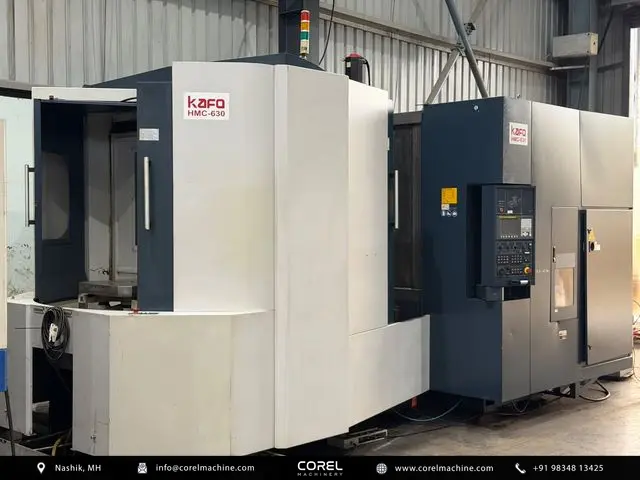
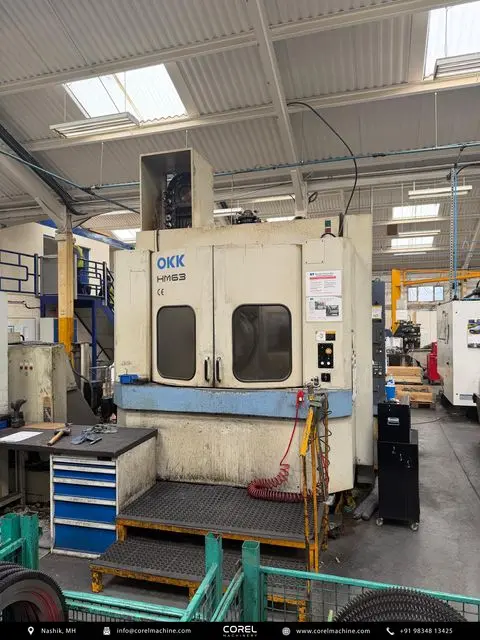
The yard holds Japanese and Taiwanese machinery with build dates spanning 2001 to 2008. The selection includes OKK models like the HM-40 and HM-63, a Mori Seiki HS500, and a KAFO HMC 630. Pallet changer units are available to support uninterrupted cycle runs. CNC systems feature standard Fanuc controls across listed machines, simplifying program transfer and operator training. All machines can be inspected at the Nashik yard.
Available Now

Incoming (Transit/Inspection)
Used HMC Machines delivered across India
Used and second hand HMC machines from our Nashik yard are running on shop floors in Pune, Mumbai, Nashik, Kolhapur, Aurangabad, Bengaluru, Hosur, Chennai, Coimbatore, Delhi NCR, Faridabad, Ludhiana, Rajkot and Ahmedabad. We ship anywhere in India and export worldwide.
Frequently Asked Questions
Why is an automatic pallet changer useful on a horizontal machining center?
An automatic pallet changer lets the operator clamp raw stock on an external station while the spindle cuts inside the enclosure. This eliminates spindle idle time during part loading and unclamp cycles, which is vital for multi-faced tombstone milling.
How does B-axis table indexing work on these horizontal mills?
HMCs use either full continuous B-axis contouring tables or 1-degree curvic coupling indexers. Curvic couplings deliver extreme mechanical rigidity for heavy side milling, whereas full fourth-axis rotary drives allow complex multi-axis profiling.
What determines the tooling reach on a horizontal machining center?
Tool reach depends on Z-axis column travel, spindle snout length, and tombstone face offsets. Ensure tool assembly lengths do not create interference with the tool changer door or adjacent fixtures when indexing the rotary table.
What should be verified regarding the chip disposal system on a used HMC?
Verify the condition of internal trough augers, scraper belts, and wash-down coolant pumps. Blocked chutes or bent auger flights cause chip accumulation against the Z-axis way covers, which can damage seals and linear rails.